Crofter · Pappila
Latest findings
What the archives have given up most recently.
- Väinö Augusti Säpyskä · 1891–19612 min read
From coaching inn to motor bus
Kustaa Adolf's youngest son, Väinö Augusti Säpyskä (1891–1961), was the first bus operator in the parish of Kangasala.
Read the article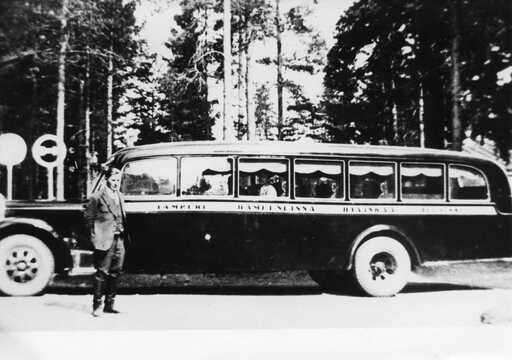
- About the researcher2 min read
Harri Salomaa
Harri Salomaa — returnee, technologist and amateur musician, great-great-grandson of Kustaa Adolf Säpyskä.
Read the article
Kangasala · Pappila · 1773–
A name that grew from
a croft into a family.
A sourced study of Kustaa Adolf Juhanpoika Säpyskä, his seven children, and how the Säpyskä name travelled through Kangasala.

01Poll tax register, 1890
01 / The decisive source
The 1890 poll tax register
One line confirmed an entire family.
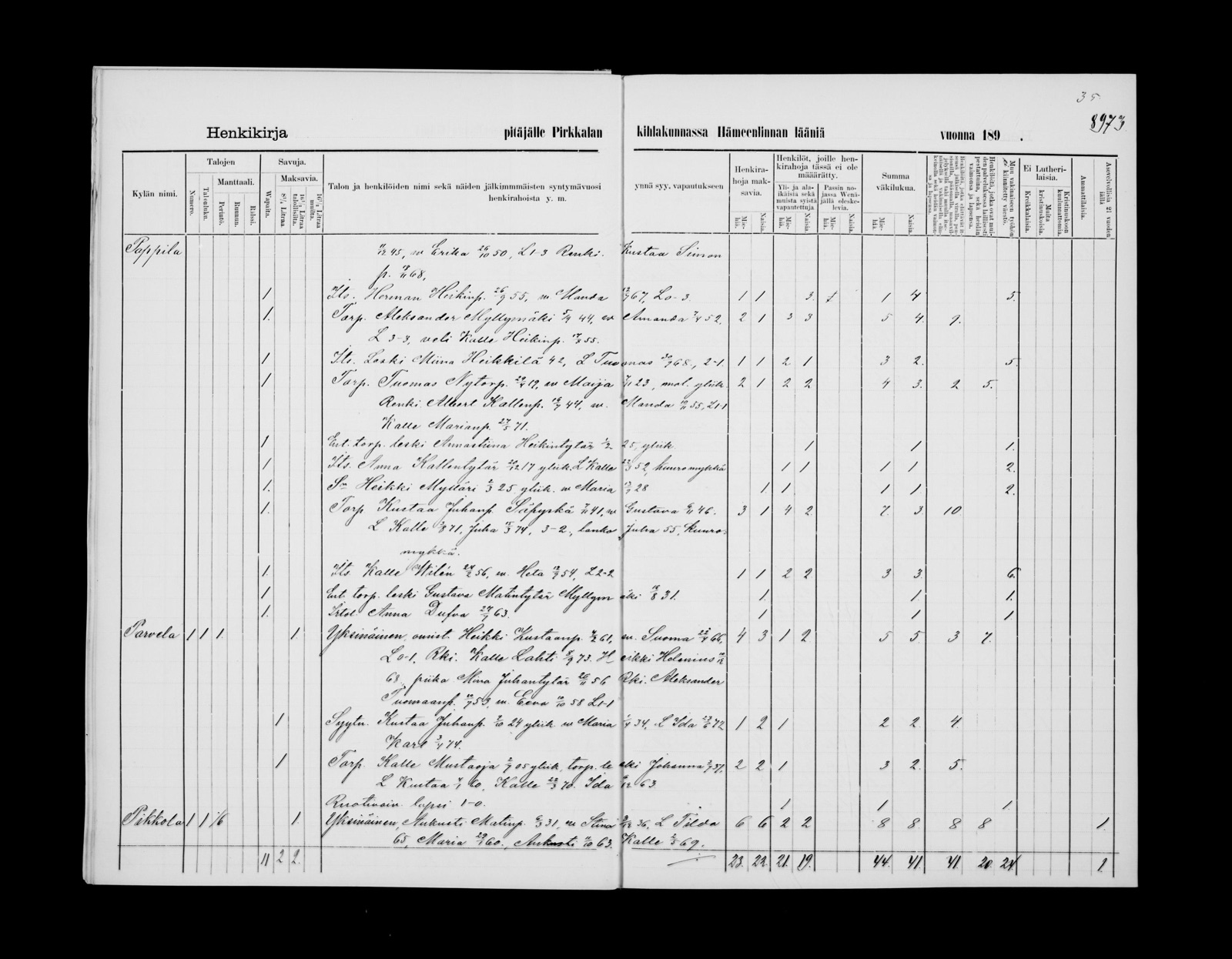
Under Kangasala's vicarage, the crofter Kustaa Juhanpoika Säpyskä is given a birth date of 7 November 1841. His wife Kustaava was born on 6 April 1846.
The sons Kalle and Juho are named. The notation 3–2 records three more sons and two daughters. The same count reappears in Eriika Kustaava Säpyskä's death notice in 1916.
7.11.1841Kustaa Adolf's date of birth
5 + 2sons and daughters
10people in one household
1773earliest record of the croft name
02 / The croft
The place the name came from.
Säpyskä was a croft belonging to the vicarage of Kangasala. Church books name it as a place as early as the 1770s — it became a surname much later, and only for those who lived there. The vicarage was a benefice whose land the crofters farmed for rent.
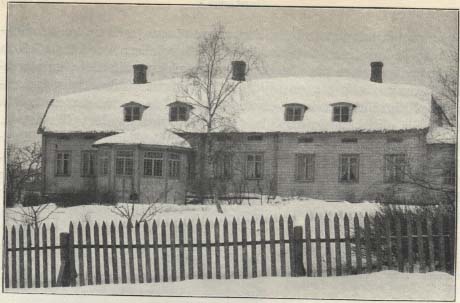
Published in Gunnar Suolahti, Suomen pappilat 1700-luvulla (Finnish vicarages in the 18th century, 1912). Plate by Aug. Schuffert. Public domain under section 49a of Finnish copyright law. Source: Wikisource.
„Prästegård Tårpare, Heikkilä, torp Säpyskä“
“Vicarage crofters, Heikkilä, Säpyskä croft.” The earliest mention found — 68 years before Kustaa Adolf was born.
Original page„Prästegårdens Torpare, Heickilä, Säpyskä“
“The vicarage's crofters.” The heading places Säpyskä unambiguously among the vicarage's crofts.
„Prästegården, torp Heickilä, (Säpyskä) Lepistö torp“
Säpyskä and Lepistö are two names for the same croft, which is why old books have to be searched under both.
Original page„Pappila Säpyskä torp“
“Vicarage, Säpyskä croft.” The croft now has a page of its own — an established dwelling, no longer a line under someone else's heading.
„Prestgården, torparen Annala, Säpyskä eller Lepistö“
“Säpyskä or Lepistö.” The double name continues into Kustaa Adolf's youth.
Original page„Prestgården torpare, Heikkilä torp, Säpyskä eller Lepistö torp“
The last entry before Kustaa Adolf married into the croft on 8 November 1870.
Original page
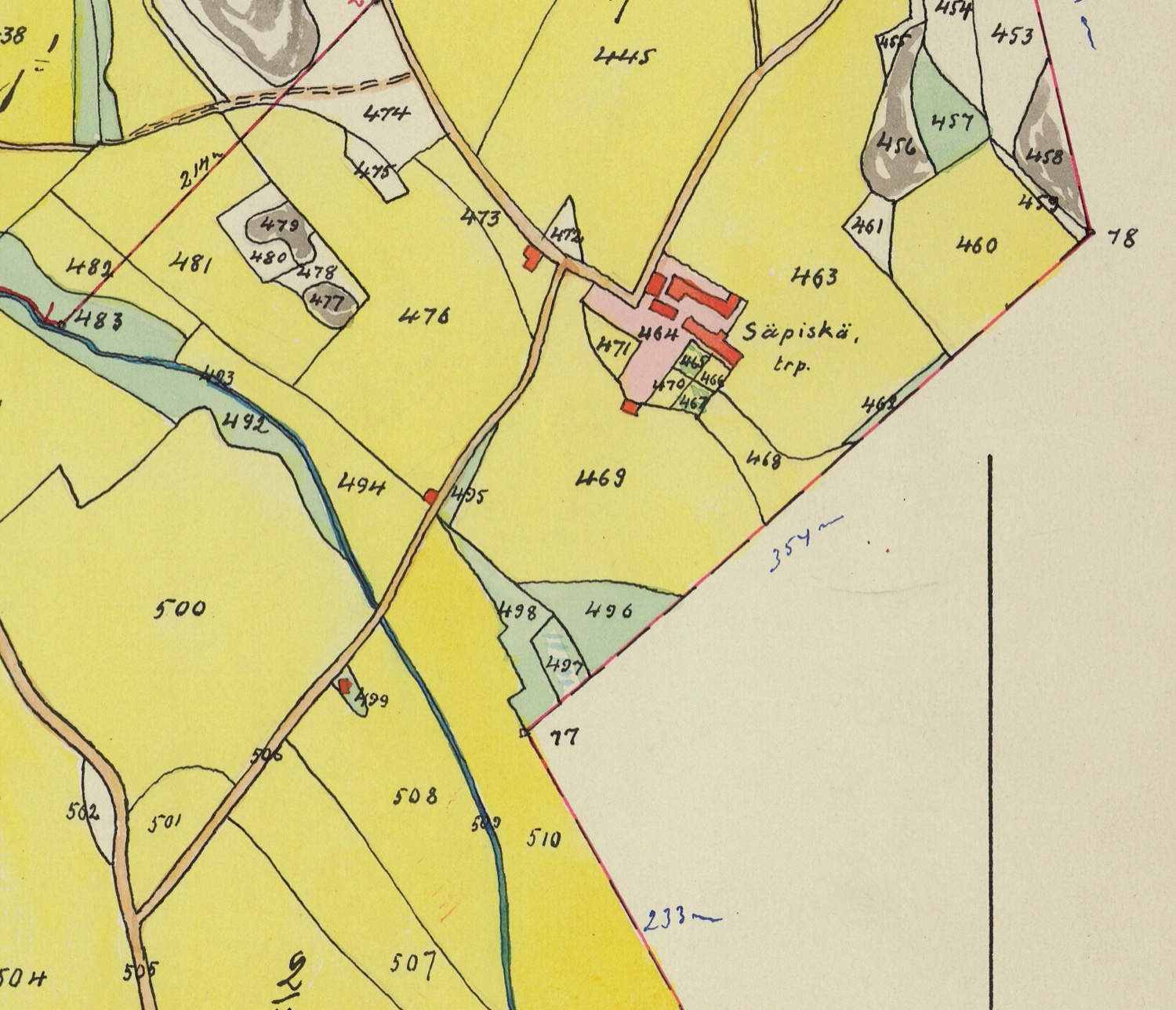
The croft was found on a map.
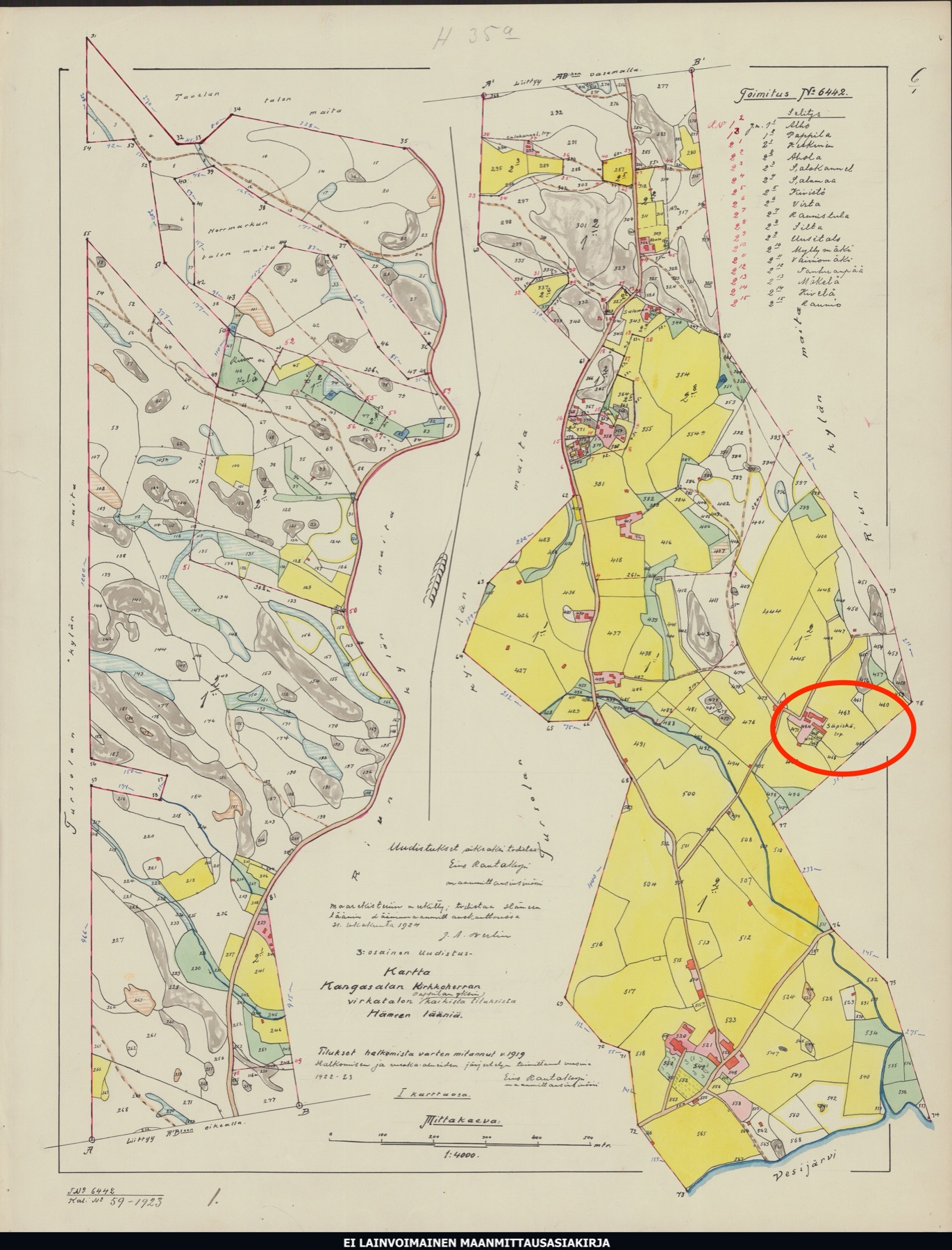
The 1923 partition and tenancy survey of the Kangasala vicarage benefice — survey no. 6442, scale 1:4000, plots measured in 1919 — places the label “Säpiskä, trp.” beside a group of red buildings. Around it lie parcels 464–471, a road and a stream. Trp. is short for torppa, croft.
The label is decisive because the name sits on the buildings rather than on a field. It ties the croft name in the church books to a specific yard.
The map was drawn during the crofters' emancipation, when tenancies were being turned into independent holdings. The vicarage had just been rebuilt: the stone main house was completed in 1917, six years before this survey. Säpyskä does not appear in the survey's list of holdings — the historical croft name survived as a place name, and the new holding most likely took another.
Kustaa Adolf did not inherit the name. He married it.
The Säpyskä family tree (MyHeritage, exported 31 July 2026) connects Thomas Henricsson Säpyskä, born 1794, directly to this family. His daughter Justina Elisabeth (12 October 1821 at the vicarage – 30 June 1877 at Säpyskä croft) was Eriika Kustaava's mother. Thomas was therefore Eriika Kustaava's grandfather.
When Kustaa Adolf Elf married Eriika Kustaava at the croft on 8 November 1870, he entered a house where the name had already run through three generations. His mother-in-law outlived the wedding by seven years and died in the same building. The name did not pass to him by descent but through place and marriage — exactly as croft names normally did.
The same tree explains an old error. Eriika Kustaava's father was Johan Gustaf Mårtensson (1822–1884), so her siblings are recorded as Kustaantytär and Kustaanpoika — daughter and son of Kustaa — after him. Two men named Kustaa were conflated, and five of her siblings ended up as Kustaa Adolf's children in the older trees.
What the map does not give. No modern coordinate, no answer on whether the buildings survive, and no name for the holding the croft became. Those need the map georeferenced and the survey's own schedule of allotments. The map also carries no residents' names — it shows where the buildings stood, not who lived there in 1923. Note the spelling too: the surveyor wrote Säpiskä, the church books Säpyskä.
03 / The core family
What the sources now say.
Green means confirmed by a document. Amber means the person fits the family strongly but still awaits confirmation from a parish register.
Kustaa Adolf
Born at Neulaniemi in Orivesi under the name Elf. Date of death confirmed from his gravestone.Mistress of the croft · Pappila
Eriika Kustaava
Säpyskä
Father Johan Gustaf Mårtensson, mother Justina Elisabeth. Married at the croft on 8 November 1870.Kalle
SäpyskäJuho
later SalomaaVihtori
later SalminenOskar Adolf
later SaloHilma Maria
SäpyskäIida Kustaava
SäpyskäVäinö Augusti
Säpyskä04 / The direct line
Five surnames, nine generations.
Säpyskä is neither the beginning nor the end of this line. The name appears in the fifth generation and gives way in the next. On either side stand Selin, Grönvall, Elf and Salomaa — evidence that in the 18th and 19th centuries a surname was tied to a place, not inherited.
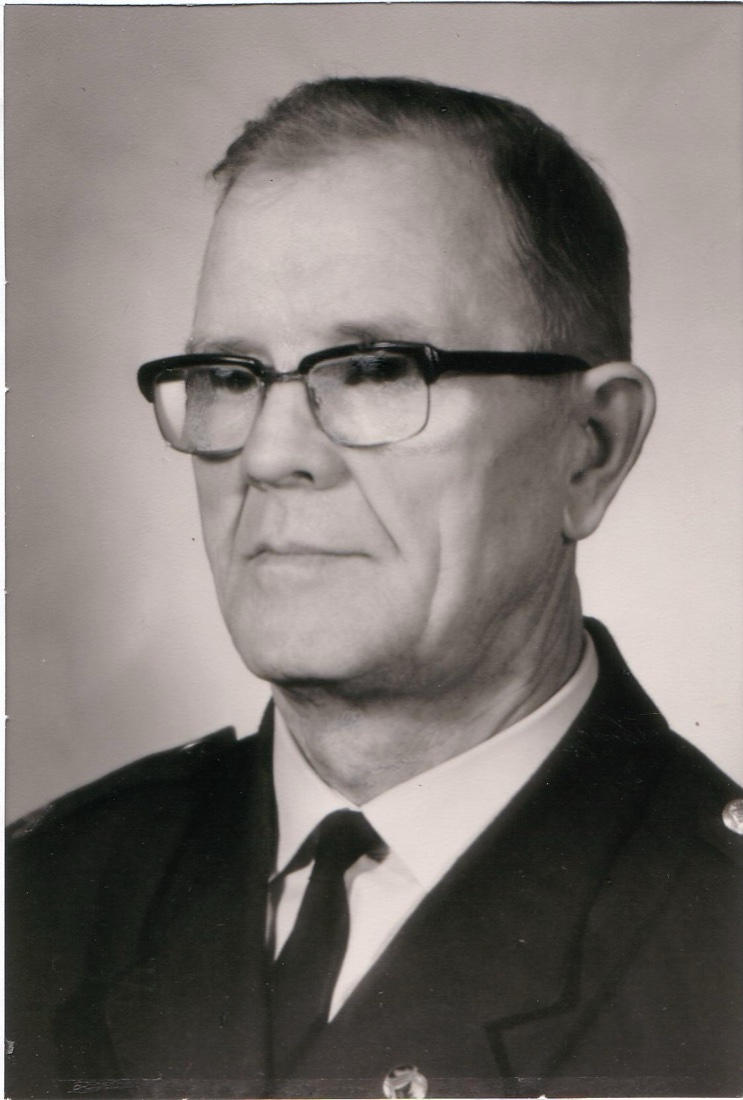
Family photograph. Neither the year nor the type of uniform is confirmed.
- Oldest generation · Selin
Aatami Vilhelminpoika Selin
A soldier. Married 6 October 1728 at Kangasala. The birth year is uncertain: the family tree gives about 1677, another record about 1703. The latter fits the marriage and the first child's birth in 1729. - Name changes · Grönvall
Heikki Aataminpoika Grönvall
Born at Kangasala. Two versions of his death exist: 15 July 1807 at Voitila (MyHeritage) or 15 September 1807 at Utterberg (Geni), both in Orivesi. - Name changes · Elf
Erkki Heikinpoika Elf
born at Päilahti, died at Säynäjoki in Orivesi Juho Erkinpoika Elf
born at Vehkala in Orivesi- Name changes · Säpyskä
Kustaa Adolf Juhonpoika Säpyskä
born at Neulaniemi in Orivesi, died at Kangasala - Name changes · Salomaa
Johan Jakob (Juho Jaakoppi) Salomaa
Born at Säpyskä croft, died at Kangasala. Wife Amanda née Lehtimäki (1883–1924). In 1924 the family were still landless; by the 1930s they held a farm called Salomaa at Pappila. Sulo Einari Salomaa
A carpenter by trade. Moved from Pappila to Messukylä in 1935, where the next generation was born. Second deputy chief of the Kangasala volunteer fire brigade in 1965 and still in its leadership in 1972; founded in 1880, it is the first rural fire brigade in Finland.Reijo Eino Johannes Salomaa
born at MessukyläHarri Salomaa
born at Aitolahti
Salomaa came about the same way Säpyskä did.
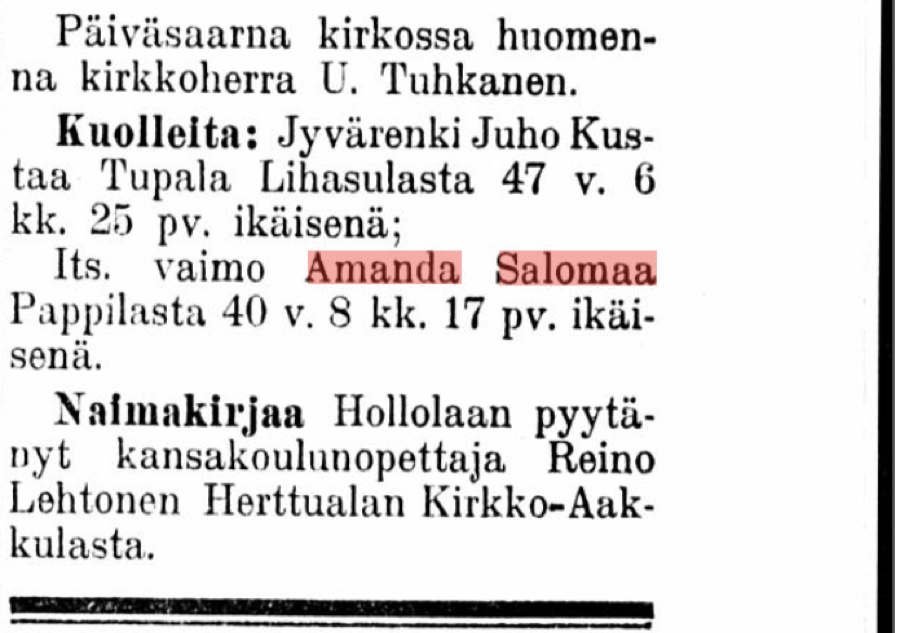
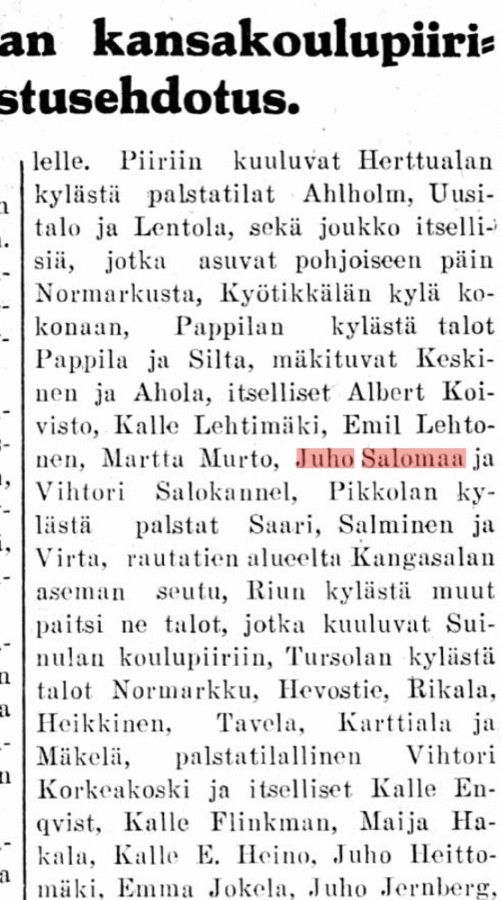
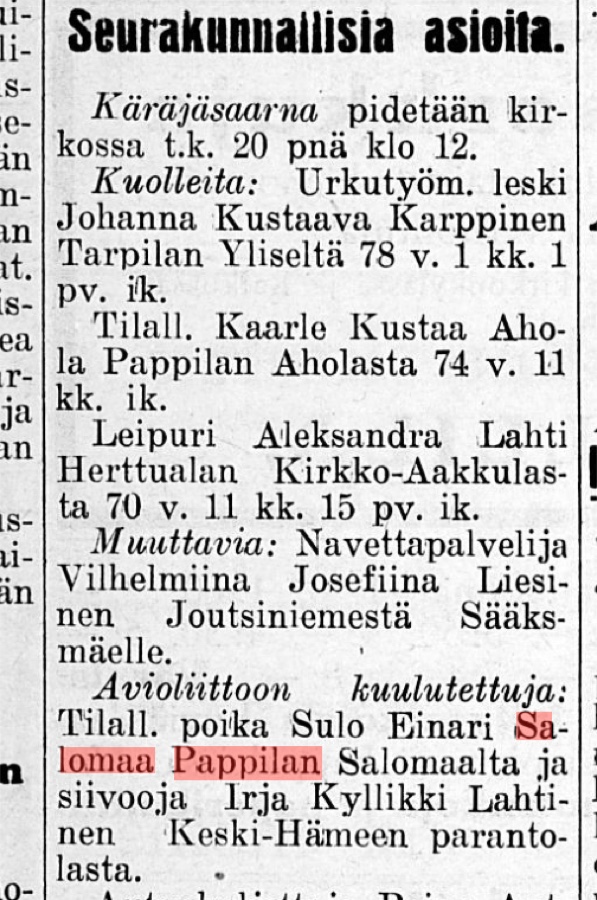
Juho Jaakoppi was born at Säpyskä croft in 1874. In 1924 the family were still itselliset — landless — as his wife Amanda's death notice records: “Its. vaimo Amanda Salomaa Pappilasta”, the wife of a landless man, from Pappila. By 1933 the standing had changed: Sulo appears in marriage banns as “tilallisen poikana Pappilan Salomaalta”, the son of a landholder at Salomaa in Pappila.
So by the 1930s the family held a farm called Salomaa in Pappila village — and the surname matches it. The same mechanism as the croft, two generations later: the name followed the place. Säpyskä became Salomaa because the family moved from Säpyskä to Salomaa.
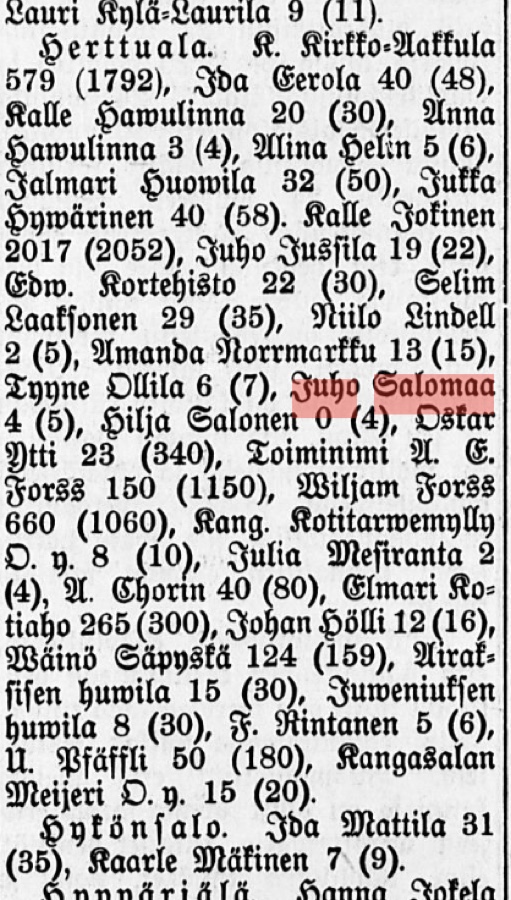
In the 1919 tax list, under Herttuala, both of Kustaa Adolf's sons appear: Juho Salomaa 4 (5) and Wäinö Säpyskä 124 (159). Väinö had just taken over the station's horse-drawn line and kept the coaching inn; Juho had no land. A thirtyfold difference between two brothers in the same column.
One generation, four surnames.
The clearest evidence is in Heikki Aataminpoika's children. All were born Grönvall, but as adults they were recorded under different names: Brita Heikintytär Utter, Matti Heikinpoika Mattila (b. 1755), Erkki Heikinpoika Elf (1762–1829) and Juho Heikinpoika (1766–1843), who appears in the sources as both Mikkola and Eerola. Siblings, one father, four names.
The name followed the farm, not the father. It is the same logic that later turned Kustaa Adolf Elf into a Säpyskä and his son into a Salomaa — which makes the Säpyskä name's origin in a croft name not an exception but the rule.
The names themselves say as much. Elf is the pre-1906 Swedish spelling of älv, a river — as in Göta elf, now Göta älv. Elf, Grönvall and Selin are all typical of the short Swedish names given to Finnish soldiers under Swedish rule, and the oldest man traceable in this line, Aatami Selin, is recorded as a soldier. The family carried three borrowed names before it took a fourth from a croft. No document has been found showing that these particular names were assigned as soldiers’ names; the inference rests on the type of name and on Aatami’s occupation.
This section draws on trees compiled by other researchers — the Salomaa tree (MyHeritage, exported 12 April 2026) and Geni's World Family Tree — rather than on original archival sources. The trees disagree with each other about the dates of the oldest generations and in places about names, and those conflicts are shown here rather than resolved by picking one version. The section is therefore less well attested than the rest of this site and still awaits confirmation from parish registers.
05 / Timeline
From a croft name to the history of motor traffic.
The timeline joins the fixed points that church books, tax registers, newspapers and local history agree on.
01
The croft name in the sources
Säpyskä is recorded as a croft of the Kangasala vicarage. The name therefore denotes a place from at least the 18th century.
02
The first Säpyskä known by name
Thomas Henricsson Säpyskä is born at the vicarage's Säpyskä croft and christened two days later. His parents, Henricus Eriksson and Maria Christersdotter, do not carry the name. It came from the croft almost fifty years before Kustaa Adolf was born.
03
Kustaa Adolf is born
The 1890 poll tax register confirms the date. The parish entry recording the change from Elf to Säpyskä has still not been found.
04
Eriika Kustaava is born
The tax register records her as Kustaava. Her 1916 death notice and the matching number of children tie the records together.
05
Kalle and Juho
The two eldest sons are born. The parish register gives Carl Edvard on 31 August 1871 and Johan Jakob on 15 March 1874; the 1890 tax register names the same boys as Kalle on 18 March 1871 and Juho on 15 May 1874.
06
A father and a brother-in-law in the household
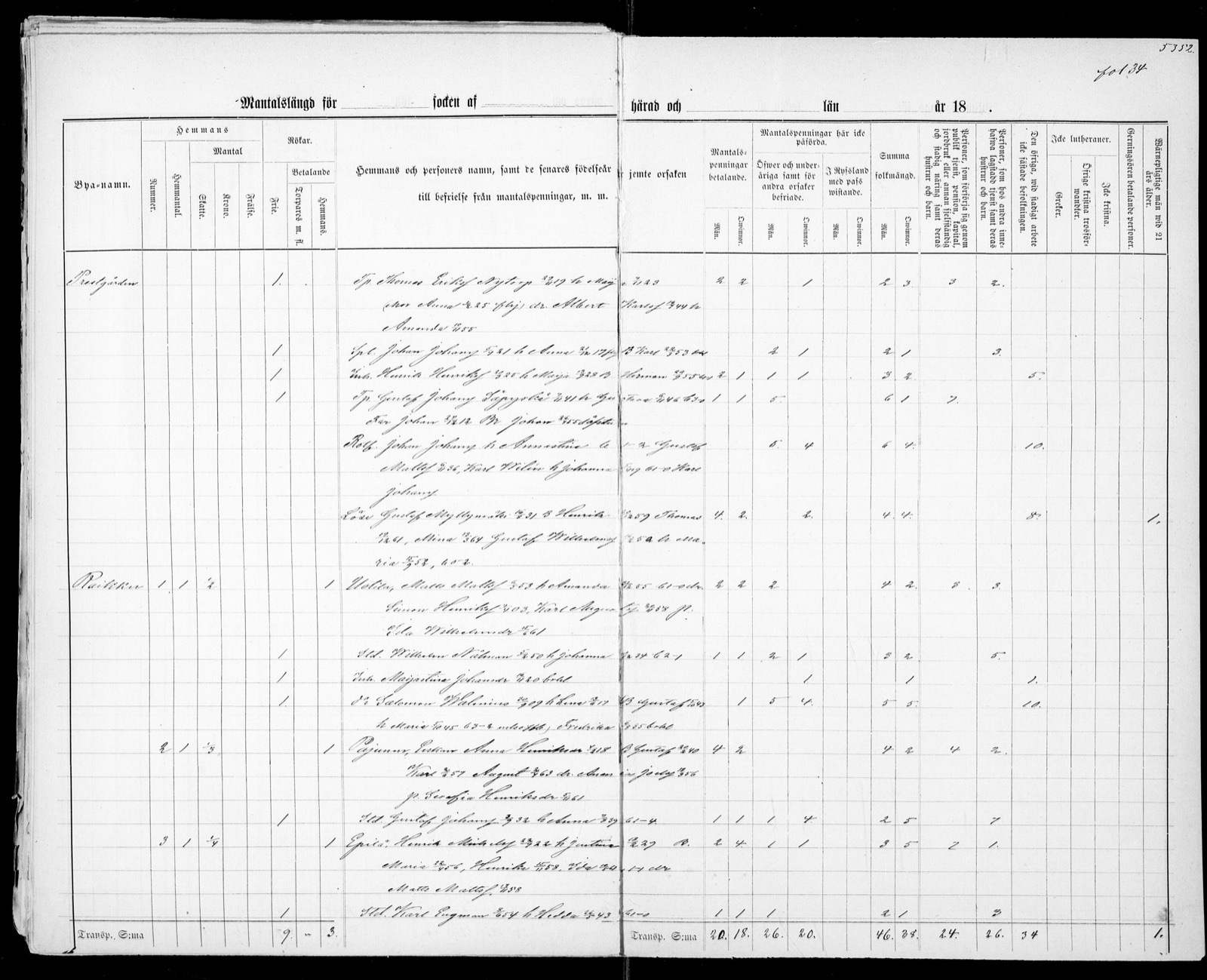
A Swedish-language poll tax page from Prestgården records the crofter Gustaf Johansson Säpyskä (7/11 41) and his wife Gustava (6/4 46), along with the resident father Johan (27/12 12) and the deaf-mute Johan (26/5 55). The year field on the page was never filled in, but the totals — six men and one woman — date it: three sons already, no daughters yet.
07
A household of ten
The vicarage household holds the parents, seven children and Kustaava's brother Juho. The count is seven men and three women.
08
The first full name in print
A newspaper reports on the crofter Kustaa Adolf Juhanpoika Säpyskä from the vicarage lands of Kangasala.
09
A position of local trust
K. Säpyskä serves on the board of the Kangasala savings bank. The person is very probably Kustaa Adolf.
10
Kustaa Adolf dies
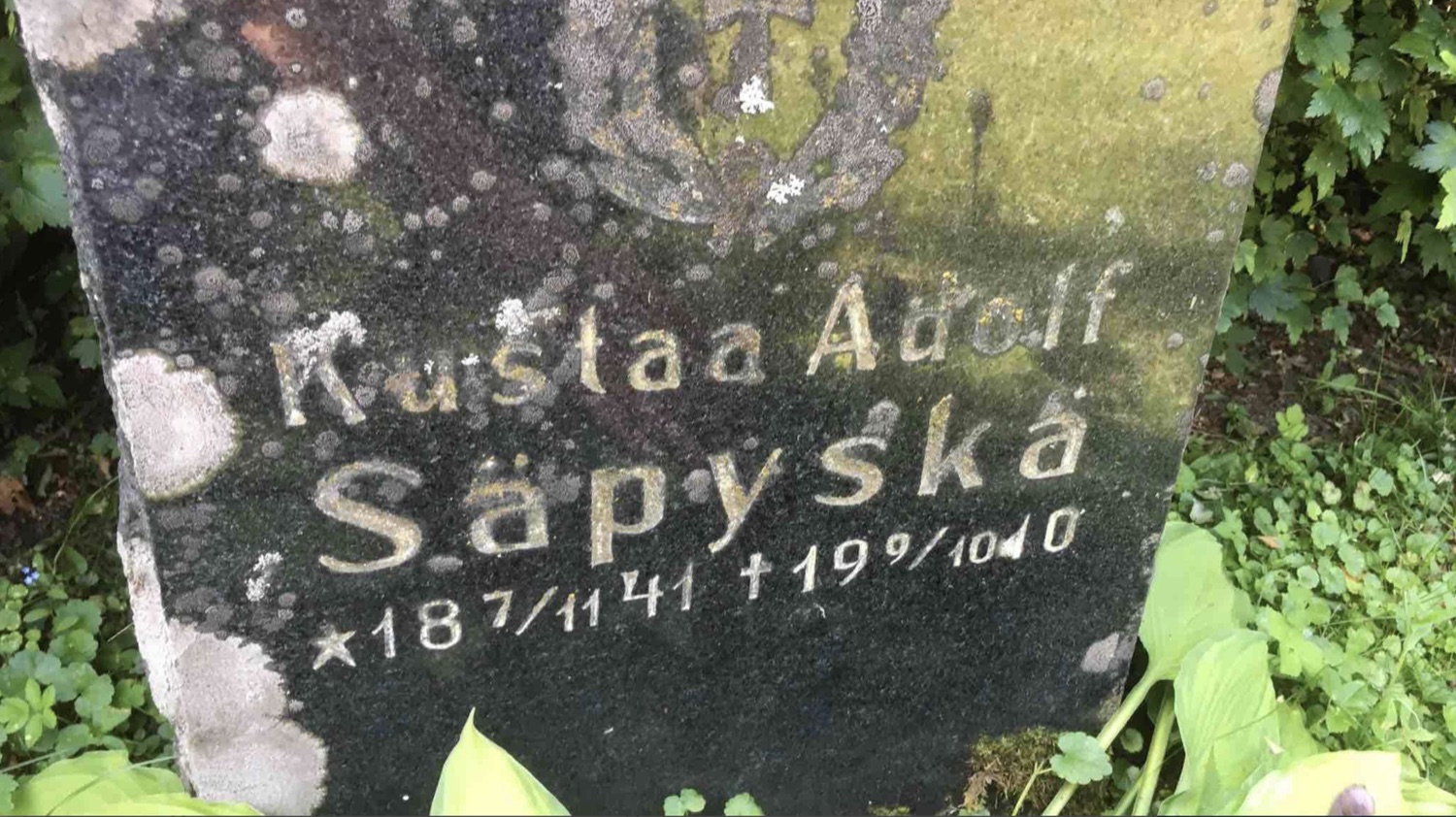
A gravestone at Kangasala confirms both dates in its own words: ★18 7/11 41, †19 9/10 10. It is so far the only original source for his date of death — the family trees say the same, but the stone said it first.
11
Eriika Kustaava dies
The death notice of the 70-year-old mistress of the croft records five sons and two daughters.
12
Seven years of the horse omnibus
In 1916 the station-to-village horse line passes from Kalle Norrman and his father Kustaa Noormarkku to Väinö Säpyskä. According to Ossi Säpyskä the line suited him well, since he already kept the coaching inn at Kangasala station. He drove a two-horse omnibus for seven years; the fare for the six kilometres to the church village was 84 penni.
13
Ossi records the history of motor traffic
Ossi Säpyskä publishes illustrated books on the history of motor traffic in Kangasala and the Pirkanmaa region.
06 / Original images
Look at the sources up close.
Optical character recognition often misreads old print. The names, ages and counts that matter here have been checked against the original images.
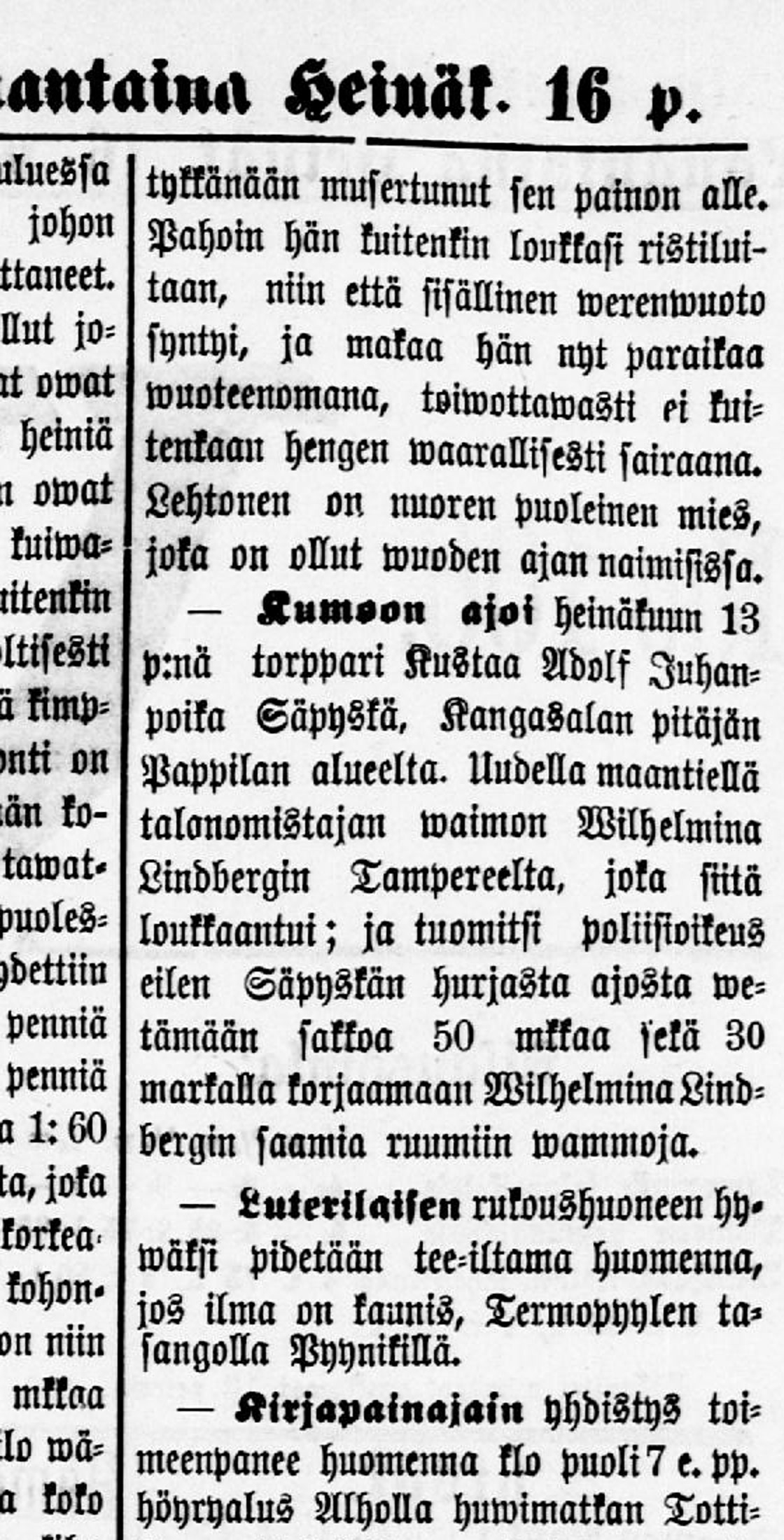
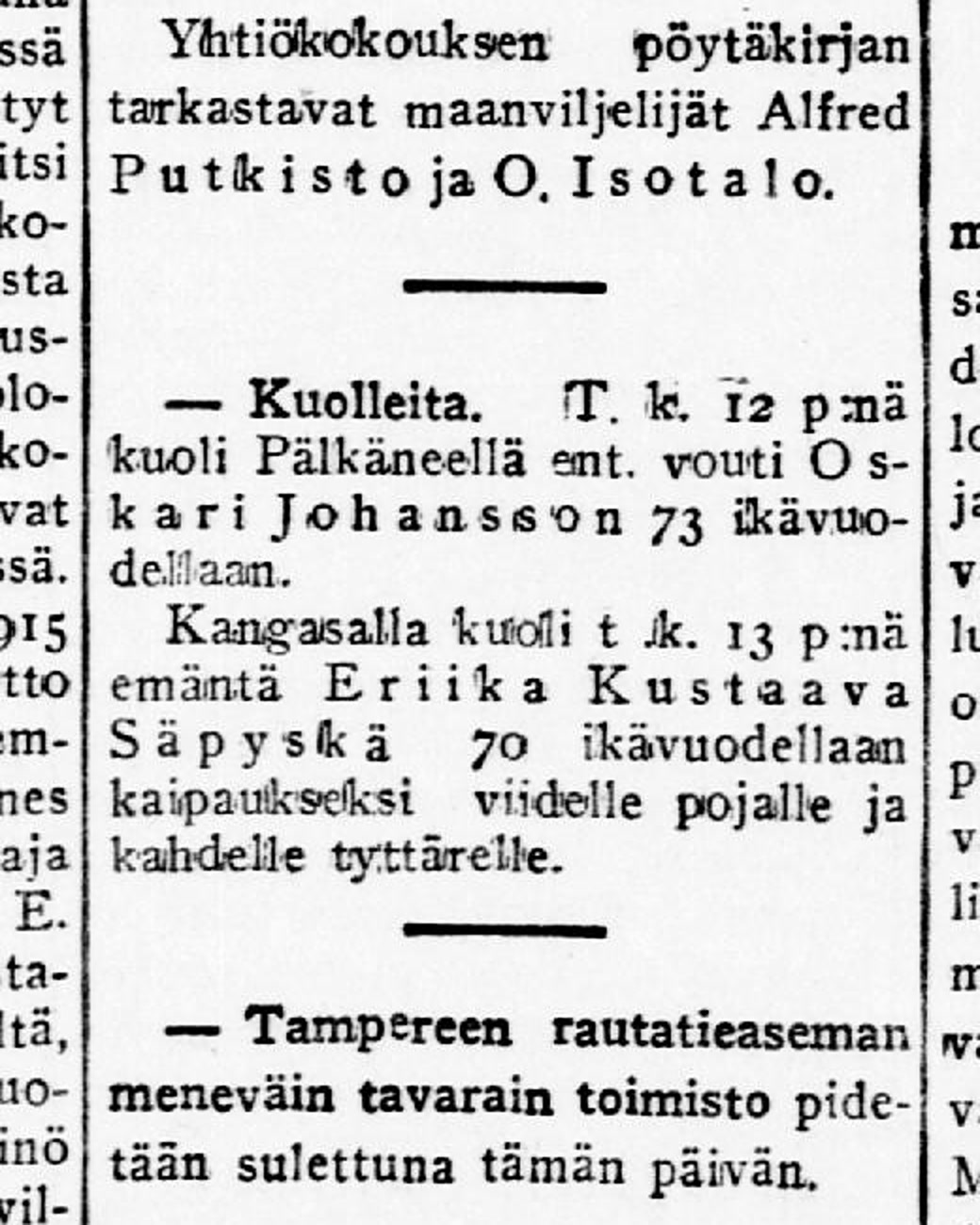
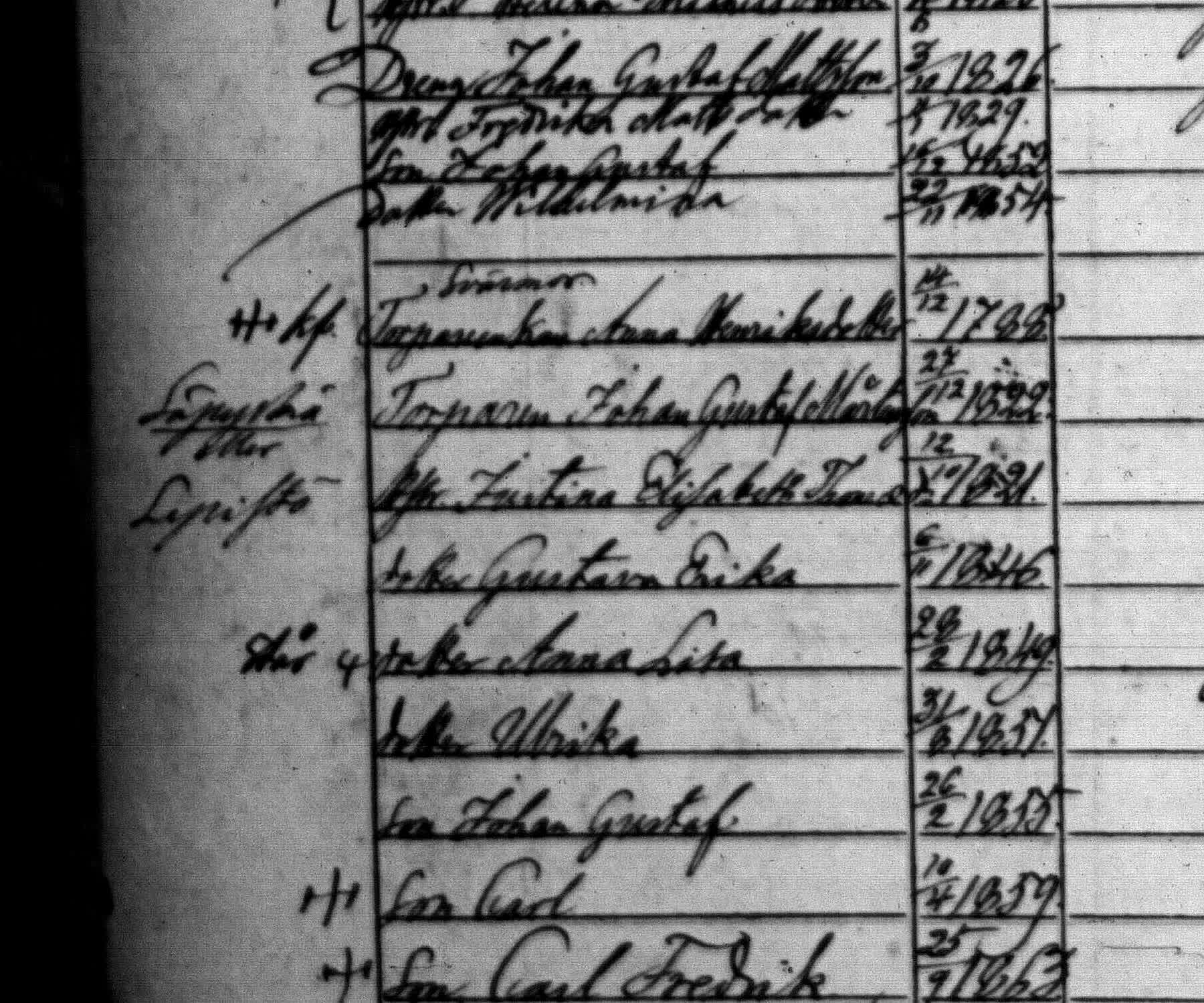
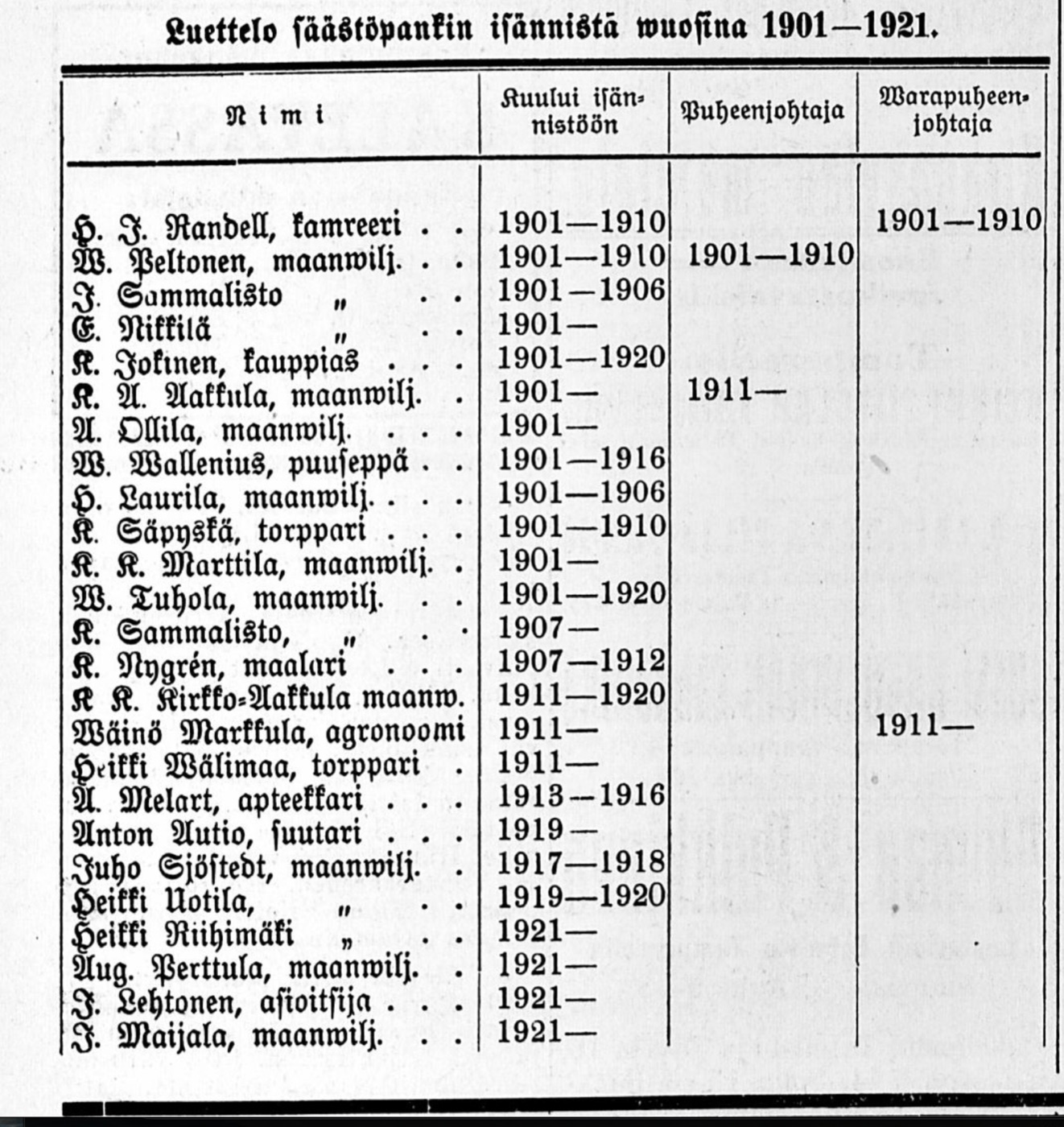
The savings bank list is printed in Fraktur, which optical character recognition reads especially badly. The line concerning Säpyskä reads, word for word: “K. Säpyskä, torppari … 1901—1910” — K. Säpyskä, crofter. He is the only Säpyskä on the list and one of only two crofters on it; the other, Heikki Välimaa, joined the board in 1911.
07 / Index of people
Other Säpyskäs in the sources.
Not every later Säpyskä has been connected to Kustaa Adolf's family. The level of proof is therefore shown with each person.
Thomas Henricsson Säpyskä
Born and died at the same vicarage croft whose name he took. His parents, Henricus Eriksson and Maria Christersdotter, carried a different name. Married Stina Johansdotter (1794–1846) on 28 December 1820. According to the Säpyskä family tree his daughter Justina Elisabeth was Eriika Kustaava's mother, making Thomas an ancestor of the family on the maternal side.
Kaarle Edvard Säpyskä — “Kalle” in the tax register
The 1890 tax register calls him “Kalle 18.3.1871”; the family trees call him Kaarle Edvard. The same man — the family has only one son born in 1871. He kept the Säpyskä name, and every living Säpyskä known today descends from him. Wife Matilda Maria née Harjunmaa, eight children. The birth date is now settled: the 1870–1879 communion book and the gravestone both give 31 August 1871, leaving the tax register’s 18 March 1871 on its own.
Johan Jakob (Juho Jaakoppi) Salomaa
“Juho 15.5.1874” in the 1890 tax register, Johan Jaakop in the parish books, Juho Juusoppi in everyday use. The same man, and the family's only son born in 1874. The handwriting has also been read as Juha, but Juho is the standard Finnish form of Johan in the 1890s — and the same brother-in-law whom the Finnish register names the same way appears as Johan in the Swedish-language poll tax page. Born at Säpyskä croft, he took the name Salomaa after the family's holding at Pappila and is this site's author's great-grandfather. Wife Amanda née Lehtimäki (1883–1924). The birth date is now settled from the original baptismal register: 15 March 1874, baptised on the 17th. The tax register had the day right but not the month, and the everyday name was Jaakoppi rather than Juusoppi — see the article “Johan Jakob, kirkonkirjan mukaan”.
Iida Kustaava Säpyskä
Born at the vicarage's Säpyskä croft. Kangasalan Sanomat records her among those moving away in 1924: “Ent. torpparin tytär Ida Kustaava Säpyskä Pappilasta Sahalahdelle” — the former crofter's daughter, from Pappila to Sahalahti. The entry ties her directly to the croft and to a former crofter. Buried in the western cemetery at Kangasala.
Hilma Maria Säpyskä
The elder daughter and the best-documented career in the family. Accepted to the Oulu deaconess institute in 1909, posted as parish deaconess to Nivala in 1911, and chosen as nurse at Nivala's municipal hospital in 1918. Three letters connected to her survive in National Library archives.
Väinö Augusti Säpyskä
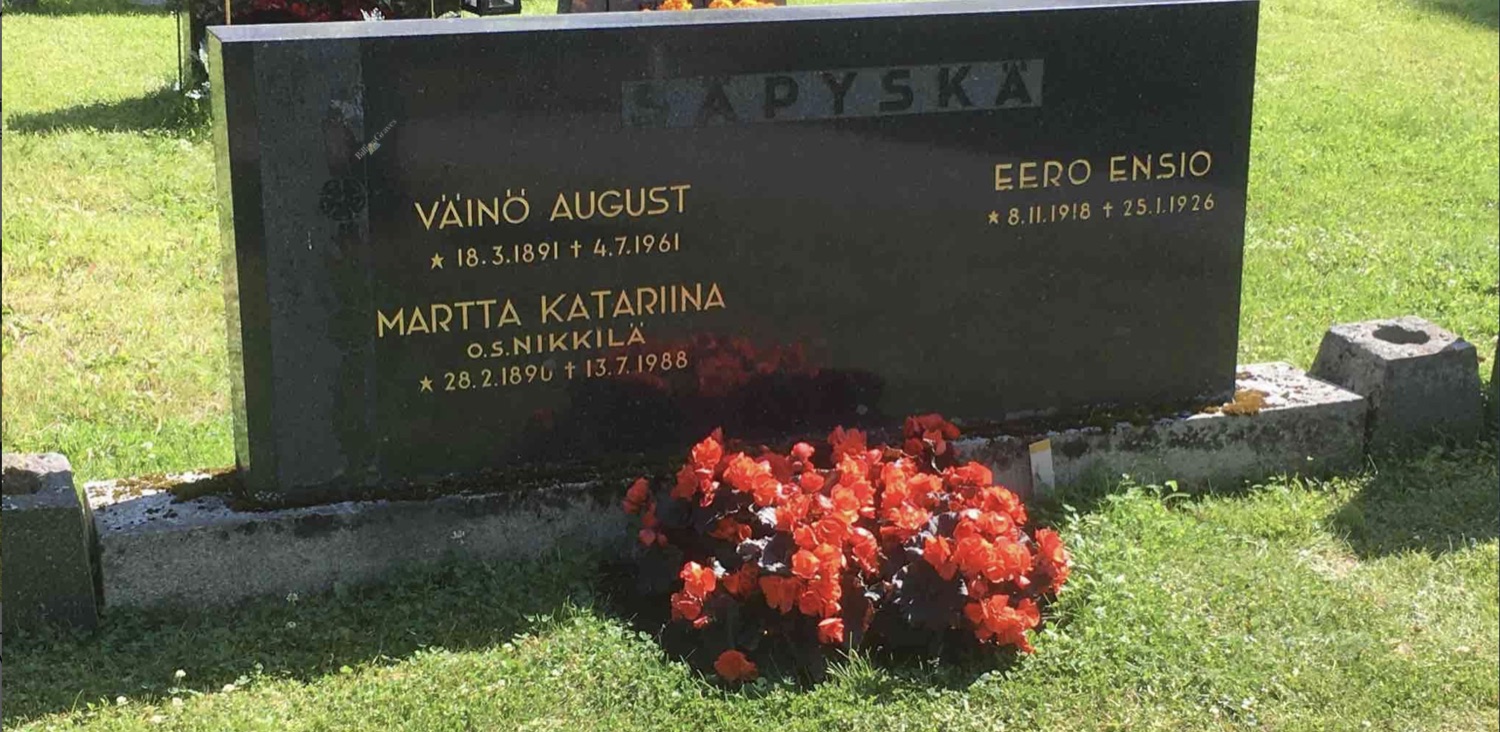
The youngest child and one of the two sons who kept the Säpyskä name. Ossi Säpyskä's book names him the parish's first bus operator and, with Erkki Hölli, among its first taxi drivers. The same book confirms his birthplace as the vicarage croft. His gravestone names his wife Martta Katariina (née Nikkilä, 1890–1988) and their son Eero Ensio, who died in 1926 at the age of seven.
The full storyOskar Adolf Salo
Born at the vicarage's Säpyskä croft and christened on 8 August 1880. He took the name Salo. A pension office card from Tampere gives his birth date and a death entry of 7 March 1956; the same card index holds Linda Salo (1878–1956), probably his wife. The 1905 company register lists a shopkeeper named Oskari Adolf Salo at Viljakkala — the full name matches exactly, but the family connection is not yet proven.
Vihtori Kustaanpoika Salminen
Born a Säpyskä, he took the name Salminen. His obituary records agricultural school, the seed-growers' cooperative, the agricultural school at Sääksmäki, and the founding and chairmanship of the Tammela cooperative dairy. He had just moved back to where he was born and bought a farm when he died at 46. The exact age given in the death notice — 46 years, 3 months, 11 days — yields a birth date of 14 December 1876 and refutes the 1877 given in the obituary.
Ossi Säpyskä
Automotive engineer and historian of motor traffic. His illustrated books are a promising further source for photographs of the family's years in transport.
Erkki Olavi Säpyskä
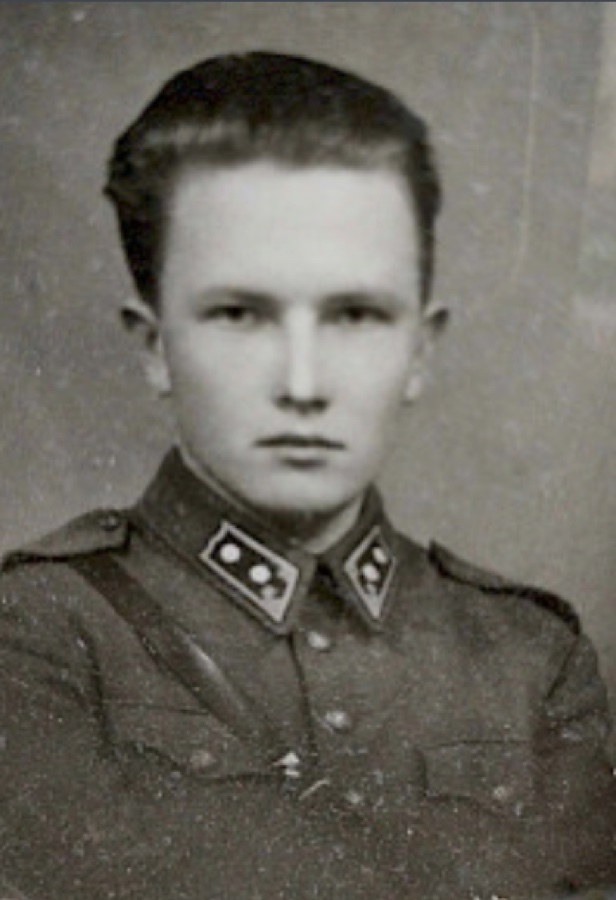
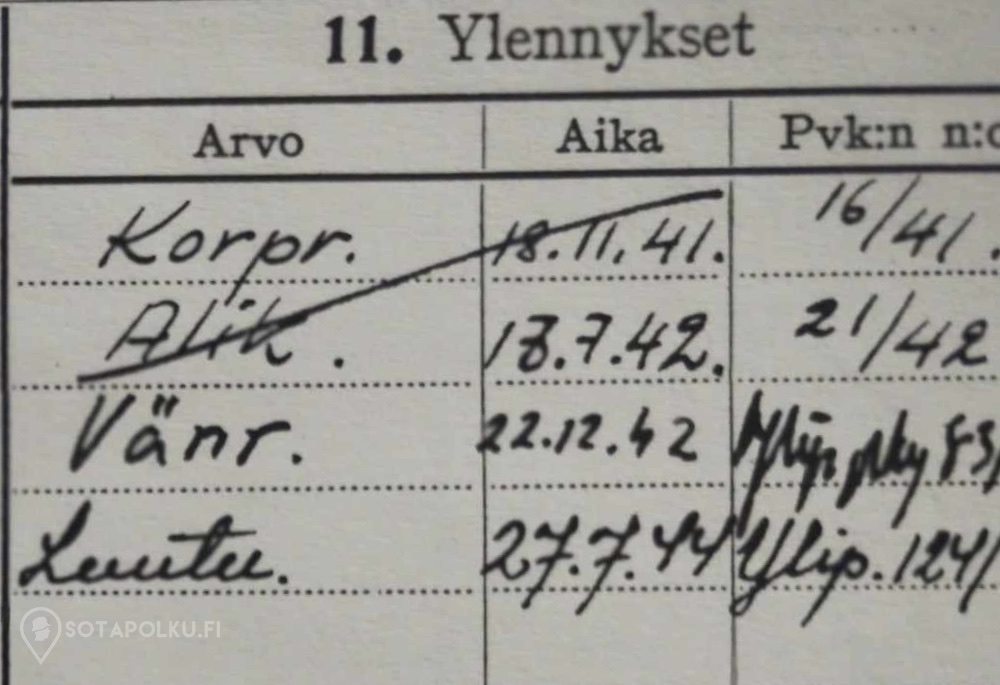
Kustaa Adolf's grandson: father Kaarle Edvard, mother Matilda Maria née Harjunmaa. He served in the Continuation War from September 1941 to November 1944, latterly in 12./JR 27. His service card shows the rise: corporal 18 November 1941, sergeant 18 July 1942, second lieutenant 22 December 1942 — the day before his twentieth birthday — and lieutenant 27 July 1944. The relationship rests on the family tree, not on an archival source.
Matti Juhani Säpyskä
Kustaa Adolf's great-grandson: father Yrjö Säpyskä (1910–1990), grandfather Kaarle Edvard. Master of the Mäkipää farm at Raudanmaa, a farmer and an active figure in Kangasala associations. The relationship rests on the family tree, not on an archival source.
08 / List of sources
Research you can retrace.
Every substantive conclusion leads back to an original document, newspaper or local history.
Säpyskä as a croft name
The vicarage croft appears in parish registers as Säpyskä, Såpyskä and Säpyskä eli Lepistö.
The earliest named Säpyskä
The FamilySearch tree places Thomas Henricsson Säpyskä's birth at the vicarage's Säpyskä croft. His parents, Henricus Eriksson and Maria Christersdotter, carry a different name, so the name comes from the place.
Kustaa Adolf's christening entry
Orivesi register of births and christenings, entry 137: born 7 November, christened 9 November, place Neulaniemi, name Gustaf Adolf. The parents' line reads Elf. The mother's possible farm name cannot be made out from the handwriting.
Kustaa's family in the poll tax register
The birth dates of Kustaa and Kustaava, the named sons Kalle and Juho, and the sexes of five younger children.
Kustaa Adolf under his full name
Tampereen Uutiset names the crofter of the Kangasala vicarage lands as Kustaa Adolf Juhanpoika Säpyskä.
The board of the Kangasala savings bank
The crofter K. Säpyskä belonged to the bank's first board and served for a decade.
Oskari Adolf Salo's country store
Finnish company register, 27 September 1905: “Oskari Adolf Salo, Viljakkalan kappeli ja kylä. Maakauppa Viljakkalan kappelissa ja kylissä” — a country store in the chapelry and villages of Viljakkala. The unusual full name matches Kustaa Adolf's son exactly, but the entry gives no birth date and no Säpyskä background.
Eriika Kustaava's death notice
The five sons and two daughters in the notice match the 1890 poll tax register exactly.
The croft in a tax list
Kangasalan Sanomat of 18 January 1919 lists, under Pappila, “Kalle Säpyskä 78” and “Säpyskän torppa 40”. The croft's name was therefore still in use nine years after Kustaa Adolf died.
The vicarage partition map
Partition and tenancy survey of the Kangasala vicarage benefice, survey no. 6442, scale 1:4000. The label “Säpiskä, trp.” locates the croft's yard.
The first bus service
Väinö Säpyskä and Ilmari Sadonoja began running between the church village and the railway station in a bus built on a Ford truck chassis.
Vihtori Salminen's obituary
Forssan Lehti of 4 April 1923 records agricultural school, the seed-growers' cooperative and the founding of the Tammela cooperative dairy. Kangasalan Sanomat of 7 April 1923 gives his age at death as 46 years, 3 months and 11 days, which settles his birth date.
Iida Kustaava moves to Sahalahti
“Ent. torpparin tytär Ida Kustaava Säpyskä Pappilasta Sahalahdelle.” The entry ties her to Pappila and to a former crofter without naming a parent.
The Salomaa family in Kangasalan Sanomat
Three entries about one family: Amanda's death notice of 17 May 1924 (“Its. vaimo Amanda Salomaa Pappilasta 40 v. 8 kk. 17 pv.”), Sulo's marriage banns of 18 February 1933 (“tilall. poika Pappilan Salomaalta”) and a moving notice of 30 March 1935 (“kirvesmies Sulo Einari Salomaa Pappilasta Messukylään”). In nine years the family rises from landless to landholding.
Eero Ensio's death notice
Aamulehti, 28 January 1926. Signed “Martta ja Väinö Säpyskä”, with the blessing at Kangasala's new cemetery. It confirms the gravestone's dates and names the parents.
Erkki Olavi Säpyskä's war service
The Continuation War service record with dates: infantry training company and NCO school in the autumn of 1941, 4./JR 48 during 1942, and 12./JR 27 from the beginning of 1943 to the armistice on 3 November 1944. The service card's promotions column gives four ranks: corporal, sergeant, second lieutenant and lieutenant.
Sulo Salomaa in the Kangasala fire brigade
At the annual meeting of 3 April 1965 Sulo Salomaa was elected second deputy chief in the brigade's 84th year. In January 1972 he appears in a photograph of the church village section's leadership. Two independent newspaper sources.
Ossi Säpyskä's book on bus traffic
Linja-autoliikenteen alkuvaiheet Kangasalla ja lähiympäristössä (The beginnings of bus traffic in Kangasala and its surroundings), Vehoniemen Automuseo, Kangasala 1985. A printed work, not online. It names Väinö Säpyskä as the parish's first bus operator.
10 / Afterword
Kustaa Adolf's descendants met in California.
In February 2015 four of his descendants stood in the same garden in Los Altos, some 8,000 kilometres from the vicarage croft. Two of them had met in Silicon Valley without knowing they were related, and only later discovered they were third cousins.
The connection had stayed invisible because it runs through the female line and the surname changed twice along the way. The same thing this site traces from the 18th century onward — a name follows a place, not a bloodline — was still hiding a family tie in 21st-century California.
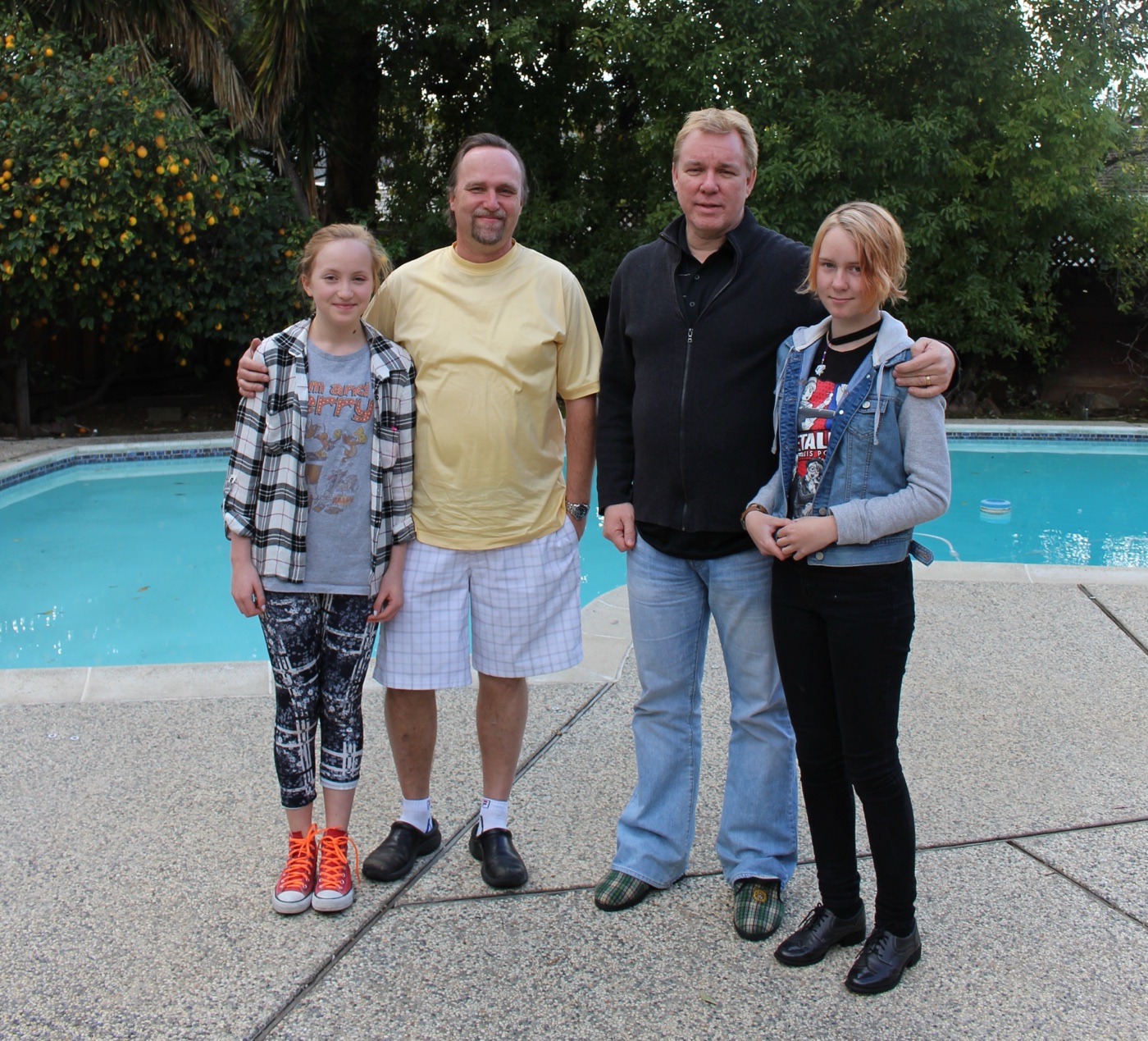
Family photograph, published with the consent of those pictured.