From coaching inn to motor bus.
Kustaa Adolf’s youngest child was born at the vicarage croft and drove the first bus in Kangasala.
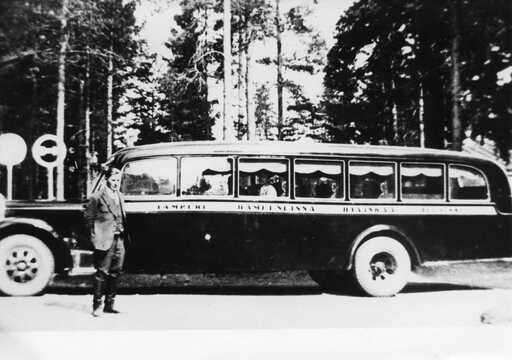
Photograph: Mobilia photographic collection. Licensed CC BY-NC-ND 4.0. The image has not been modified.
Keeper of the district coaching inn
Väinö kept the district's coaching inn at Kangasala station for ten years. The obligations included two rooms for travellers and two post horses, with two regular and two additional runs to the church village. He drove himself, helped by two or three post boys. The fare for the six kilometres was 84 penni.
Hämetär of 25 November 1915 names him: “Aseman kestikievari majatalonhoitaja Wäinö Säpyskä” — the station's coaching innkeeper. Source
The horse line passes to him
The horse omnibus line between the station and the church village — a four-wheeled carriage drawn by two horses, carrying more than ten passengers — passed from Kalle Norrman and his father Kustaa Noormarkku to Väinö. It suited him, since the horses and stabling were already in place at the coaching inn.
Ossi Säpyskä's 1985 book and the Halimaa local history, independently of each other.
The first motor bus
Väinö replaced his horse carriage with an omnibus built on a Ford truck chassis, in partnership with Ilmari Sadonoja. According to Ossi Säpyskä, Väinö was “the first bus operator in our parish”. Before this he had also carried passengers by lorry between the station and the church village.
Kangasalan Sanomat of 3 July 1937 recalls: “autoilija V. Säpyskä oli m.m. myös liikennöinyt kuorma-autolla Kangasalan asemalta kirkolle.” Source
An accident on the Tampere line
Väinö was driving the Leino & Kumpp. company's Kangasala–Tampere bus when it crashed. Aamulehti described him as having acted skilfully and coolly to the last. He suffered only minor injuries.
Aamulehti, 11 August 1933, p. 1. Source
On the company board
Väinö was not only a driver. The Finnish company register lists him on the board of Leino ja Kumpp. Oy alongside Eeti Kirjavainen, Kalle Leppänen, Kustaa Leino and Toivo Nyström. The company's declared business was motor traffic, parts and repair work.
Finnish company register 1934, p. 49. Source
The man who wrote it down
Väinö’s story is known largely because someone recorded it. Ossi Säpyskä (1924–2016) published Linja-autoliikenteen alkuvaiheet Kangasalla ja lähiympäristössä in 1985 for the Vehoniemi Automobile Museum, and three years later the broader Pirkanmaan autoliikenteen vaiheet. The 1923 photograph of the bus in the Halimaa local history comes from his photographic collection.
Ossi’s relationship to Väinö is probable but unproven. He is absent from the Salomaa family tree, and Väinö’s family record lists no children at all — even though a gravestone proves that Eero Ensio (1918–1926) existed. His second name August, and the fact that he owned a photograph taken the year before he was born, both point to a father. A birth record would settle it.
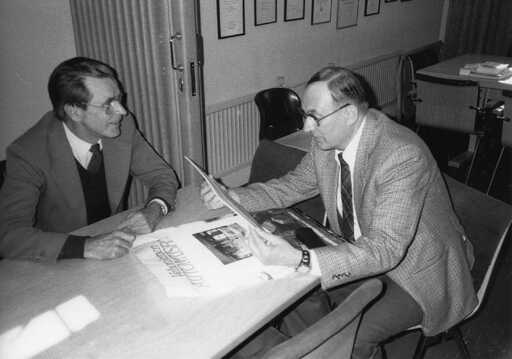
Photograph: Olavi Sallinen / Mobilia photographic collection. Licensed CC BY-NC-ND 4.0. The image has not been modified.
Family.Väinö married Martta Katariina Nikkilä (1890–1988). Their son Eero Ensio died on 25 January 1926 at the age of seven; the death notice was signed „Martta ja Väinö Säpyskä“ and the blessing was held at Kangasala’s new cemetery. Väinö died on 4 July 1961 and is buried in the same grave.